Blog / article
2 Jun 2026 · 5 min read
Web Ecosystems That Convert: who is this space for, and what action do we want that person to take?
A site without strategy is an expensive business card. Find out how to build an aligned web ecosystem that generates trust, traffic and real conversions.
Most companies launch a website and wait. They wait for traffic to appear, for visitors to grasp the value, for conversions to happen by osmosis. The problem is not bad luck — it is a lack of intent.
A site without strategy is an expensive business card. A well-built web ecosystem is something else: it is your best salesperson, available 24 hours a day, seven days a week, no days off.
Building a digital home that converts starts long before the first pixel. It starts with the right question: who is this space for, and what action do we want that person to take?
The difference between a site and an ecosystem
A site is a set of pages. An ecosystem is a living system where every element — from the homepage to the contact form, from the blog article to the call-to-action button — has a defined role and a logical link to the rest.
Think of a well-designed physical shop: the entrance creates a first impression, the route guides the customer naturally, the products sit where they make sense, and the till is positioned to close the sale without friction. Your digital home works in exactly the same way — or it should.
When there is coherence between information architecture, user experience and business goals, the result is not just a beautiful site. It is a system that works for you.
User experience as a strategic lever
There is a common belief that UX — user experience — is a design matter. In reality, it is a strategy matter. Every navigation decision, every visual hierarchy, every second of load time has a direct impact on conversion rates.
Consistent studies show that 53% of mobile users abandon a page that takes more than 3 seconds to load. Not three minutes. Three seconds. And once they arrive, they have on average less than 8 seconds to decide whether to stay or leave.
This means technical performance and experience design are not finishing touches — they are the foundation. A high-performance web ecosystem is, above all, fast, clear and action-oriented.
Every page has a job
One of the most common mistakes in web projects is treating every page the same way. The homepage does not do the same job as a service page. A campaign landing page has different goals from an about-us page. The blog exists to attract and educate, not to sell directly.
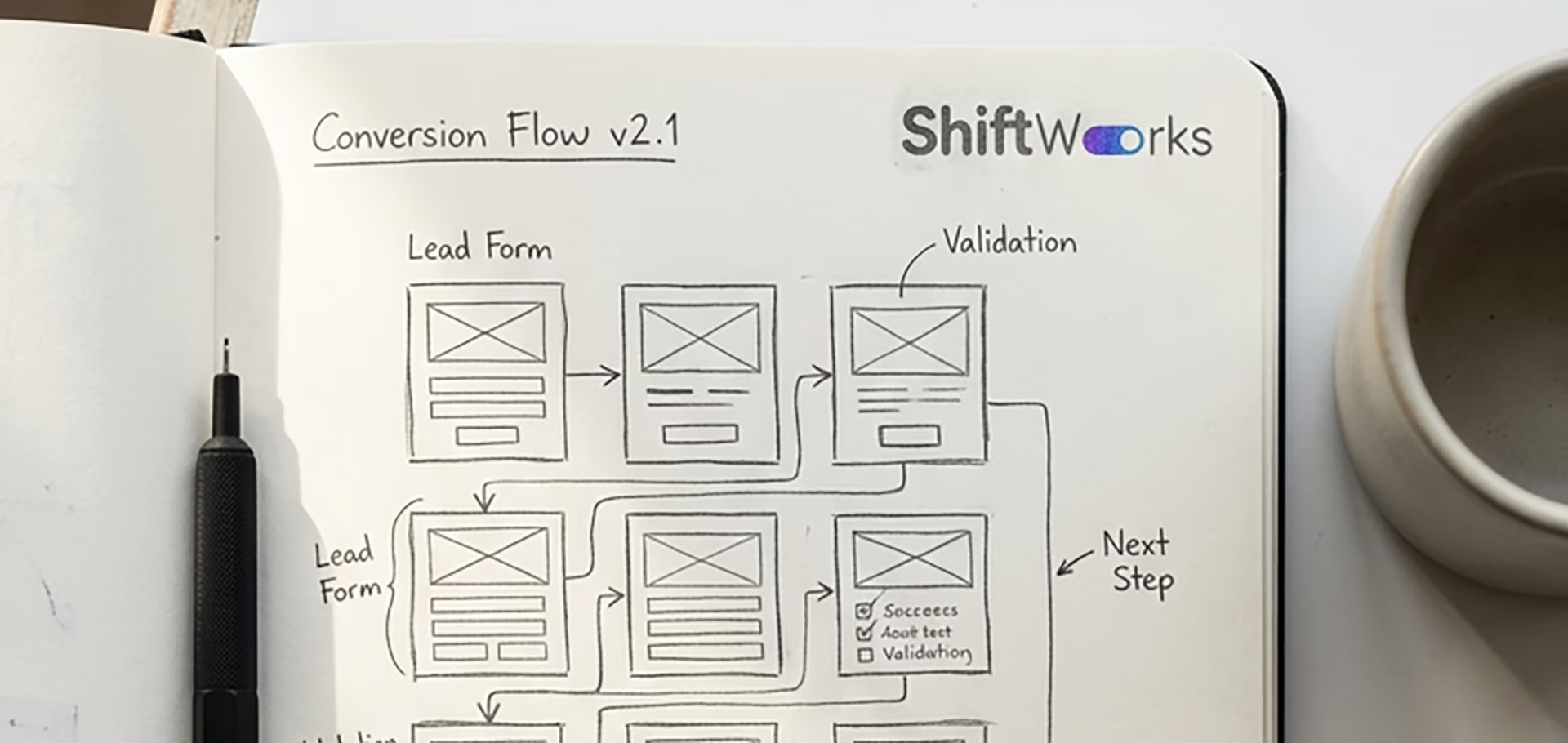
When we map a web ecosystem, we define for each page:
- —Who arrives here — the persona and the moment in the buying journey
- —What they need to feel — trust, urgency, curiosity, belonging
- —What action they should take — the next logical step in the funnel
That clarity turns generic pages into strategic touchpoints. And strategic touchpoints generate real conversions.
Perceived authority and digital trust
Conversion does not happen without trust. And trust online is built in milliseconds — through visual, social and technical signals that tell the visitor: this space is professional, this business is solid, I am in good hands.
Those signals include design quality, brand identity consistency, loading speed, testimonials from real customers, the clarity of the value proposition and even the SSL certificate visible in the address bar. None of these elements exists by accident in a well-built ecosystem.
Perceived authority is not declared — it is built. And your digital home is the main stage where that building happens every day.
Technical performance: what you don't see makes the difference
Beneath a high-performance web ecosystem sits a technical layer that rarely comes up in design conversations, but which determines the success of everything else.
Core Web Vitals, semantic HTML structure, image optimisation, smart caching, heading hierarchy, structured data — these are the elements search engines assess when deciding who to show your site to. And they are the same ones that make the user experience smooth and pleasant.
SEO and UX are not separate disciplines. In a coherent ecosystem they feed each other: a fast, well-structured site ranks better, attracts more qualified traffic, and converts more because the experience is better.
Continuous growth, not a one-off delivery
A web ecosystem is not launched and abandoned. The best results come from a continuous relationship between strategy, data and iteration. What worked six months ago may need adjusting today. New content feeds organic authority. New flows answer new business goals.
That is why at Shiftworks we do not deliver projects — we deliver partnerships. Because your digital home is a living organism, and living organisms need continuous attention to grow healthily.
The question is not “do I have a site?”. The question is “is my site working for me?”
If the answer is not a confident “yes”, it is time to rethink your digital home. Talk to us and find out how a strategic web ecosystem can turn your digital presence into a real growth engine.